AMC 10 Data Analysis: What 6 Years of Data Reveal
The AMC 10 is the gateway to AIME. But what exactly gets tested, and how has it changed?
I analyzed 6 years of AMC 10 data (2020-2025), covering both the A and B versions. The patterns are clear—and different from what most prep advice suggests.
The Big Picture: What Dominates?
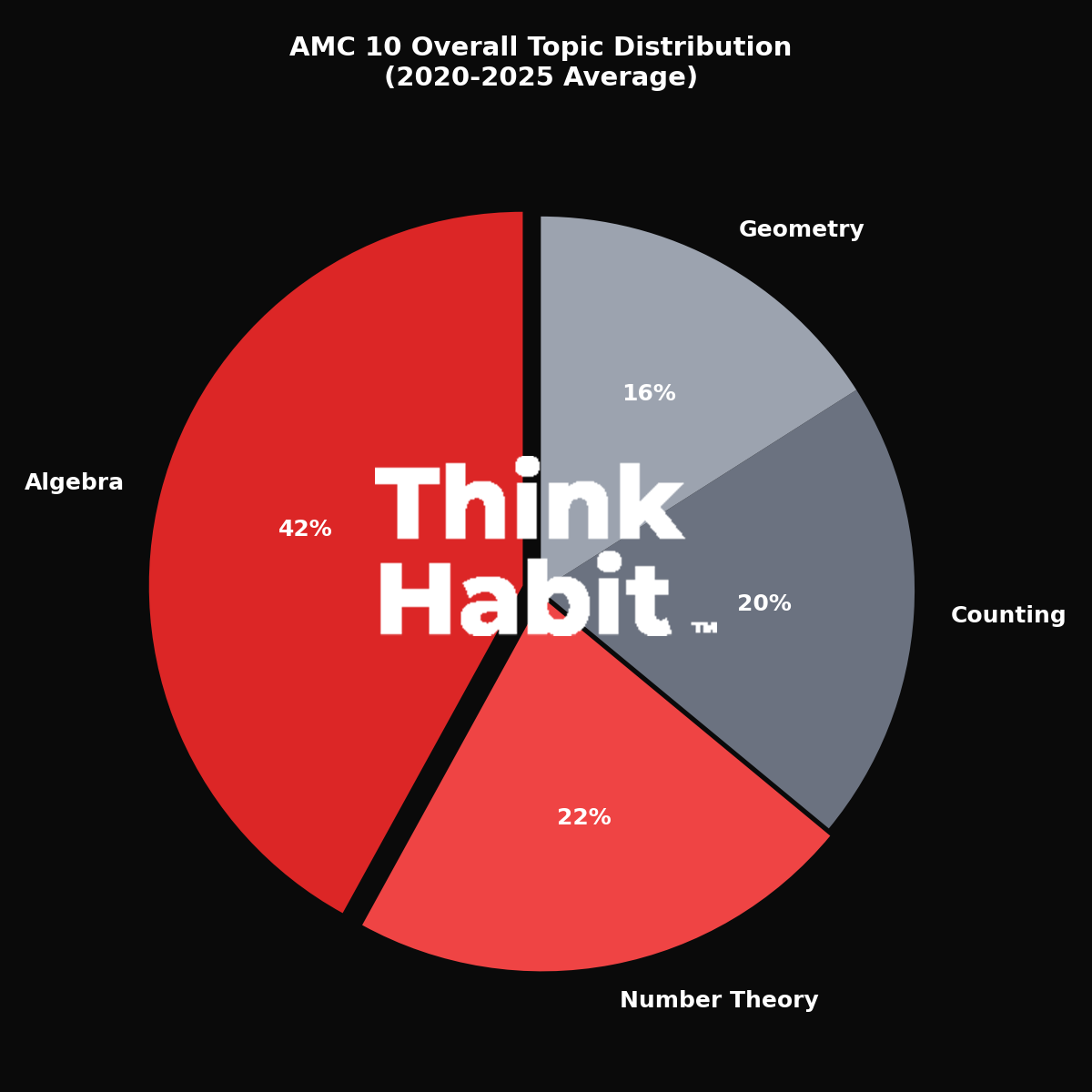
Let's start with the overall topic distribution.
![amc10_total_distribution.png]
| Rank | Topic | Percentage |
|---|---|---|
| 1 | Algebra | 42% |
| 2 | Number Theory | 22% |
| 3 | Counting & Probability | 20% |
| 4 | Geometry | 16% |
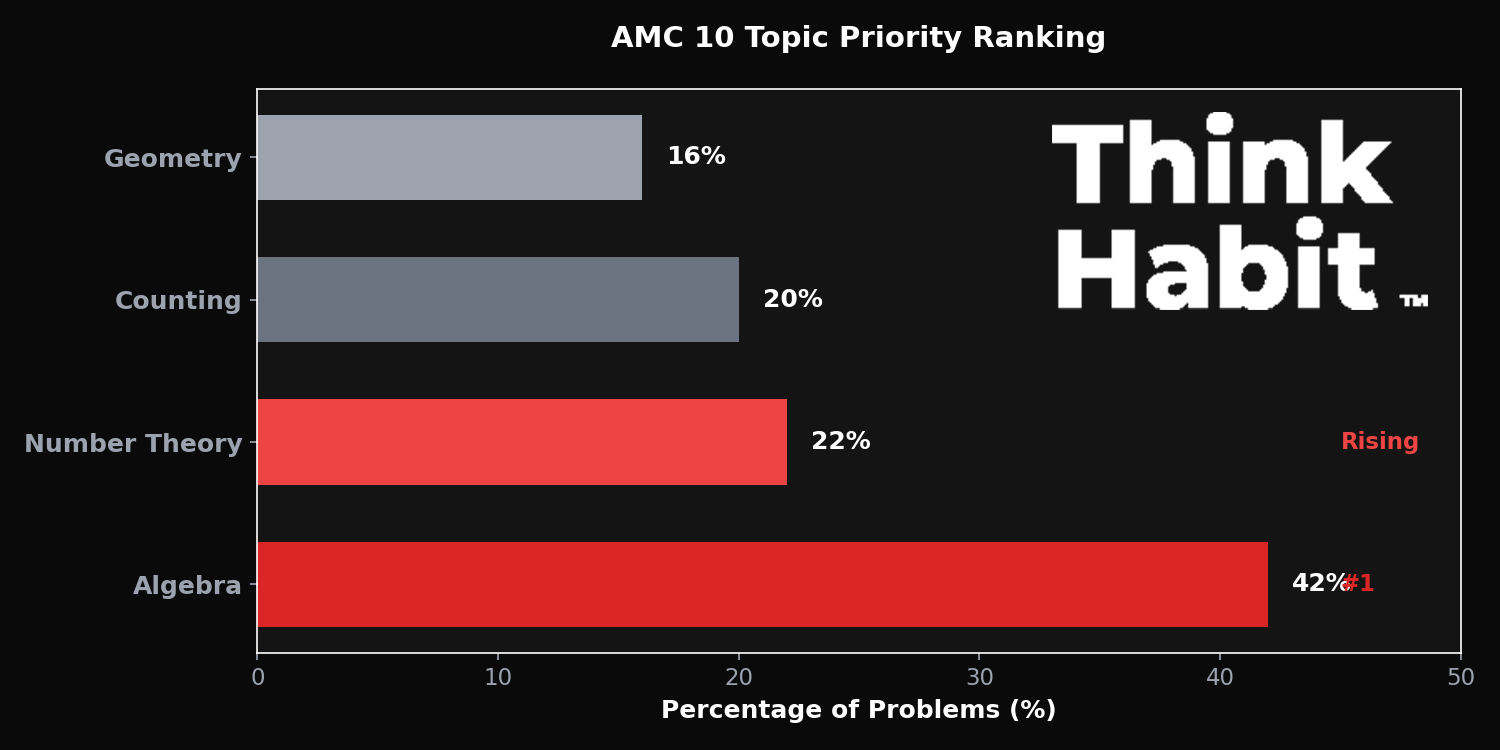
Algebra dominates at 42%. That's nearly half the test. If your algebra is weak, AIME qualification is a distant dream.
But here's the surprise: Number Theory is now #2 at 22%. Five years ago, it was the least tested topic. More on this below.
Year-by-Year Trends
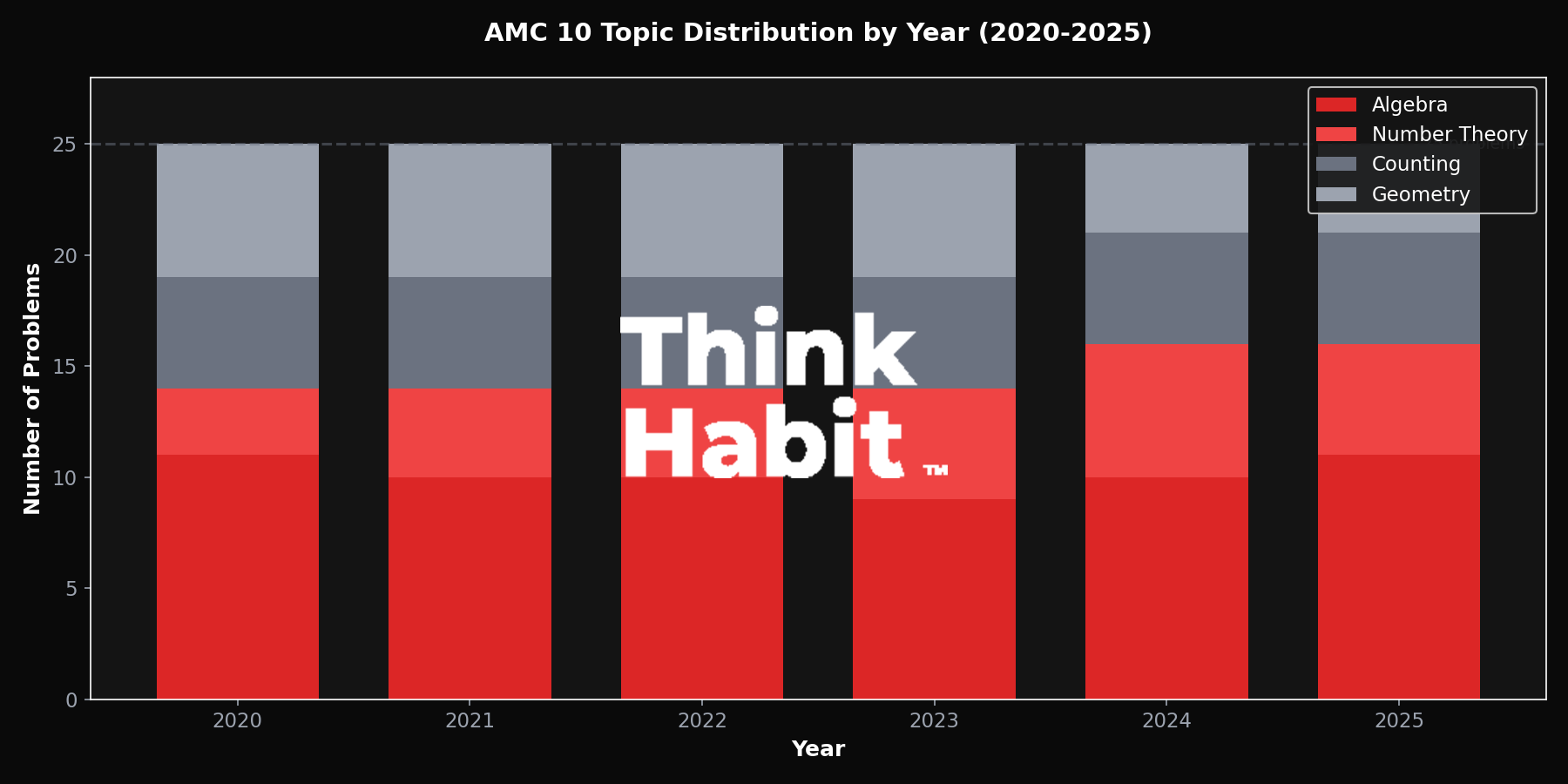
The yearly breakdown reveals important shifts.
Key observations:
- Algebra is stable but heavy. Consistently 9-11 problems per test. This won't change.
- Number Theory surged. From 3 problems in 2020 to 5-6 problems now. This is the fastest-growing topic.
- Geometry is declining slightly. From 6 problems to 4. Still important, but less dominant than in AMC 8.
- Counting stays constant. About 5 problems per test, every year. Predictable.
The Rising Star: Number Theory
This deserves its own section.
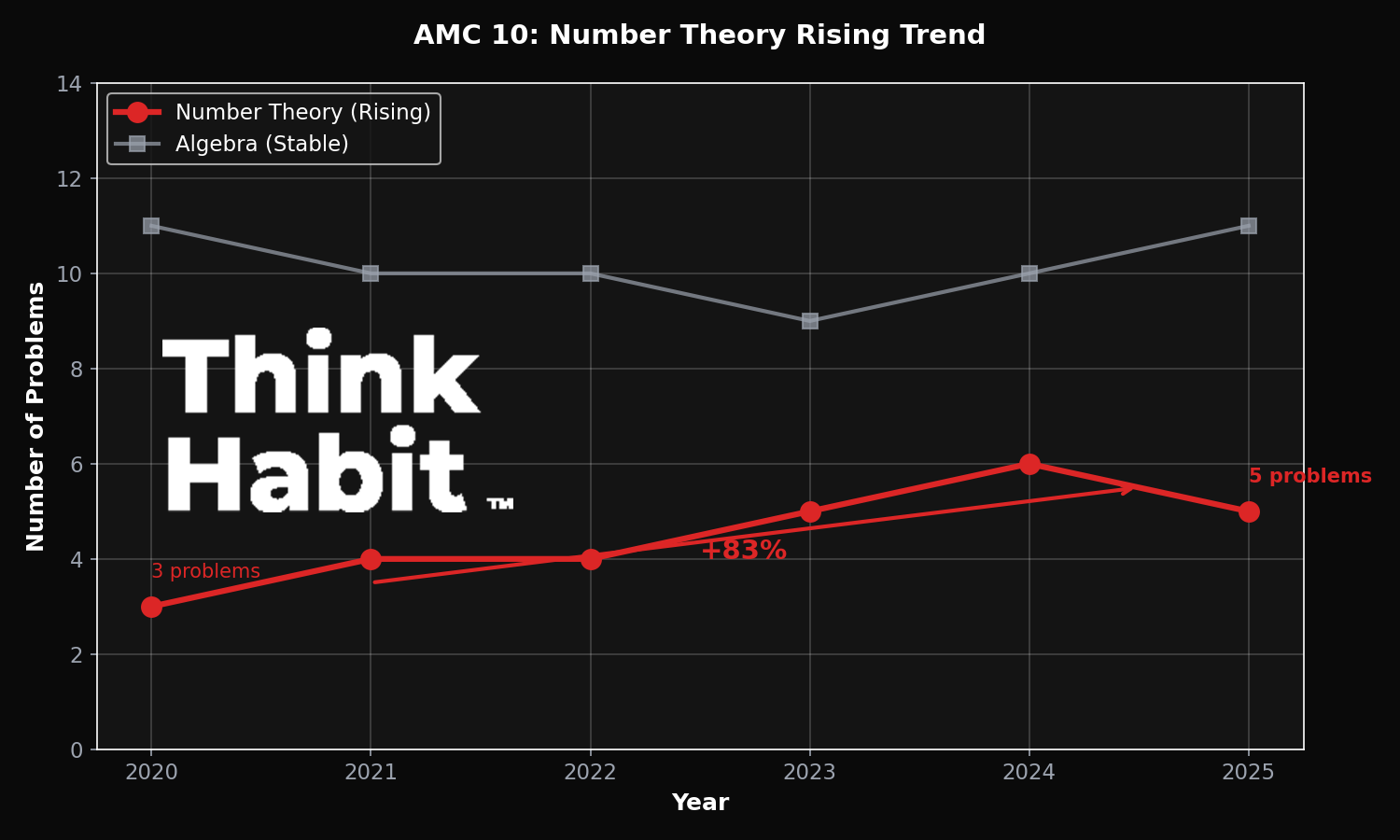
Number Theory went from 3 problems (12%) in 2020 to 5-6 problems (22%) in recent years. That's an 83% increase.
Why does this matter? Because most school curricula barely cover number theory. Topics like:
- Modular arithmetic
- Prime factorization techniques
- Diophantine equations
- Number bases
- Divisibility properties
These are not taught in typical Algebra 1/2 classes. If you don't study them separately, you're giving up ~5 problems.
Hard Problems: Q21-25 Analysis
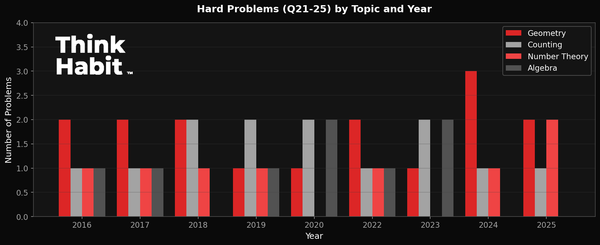
AIME qualification often comes down to the last 5 questions. What topics appear there?
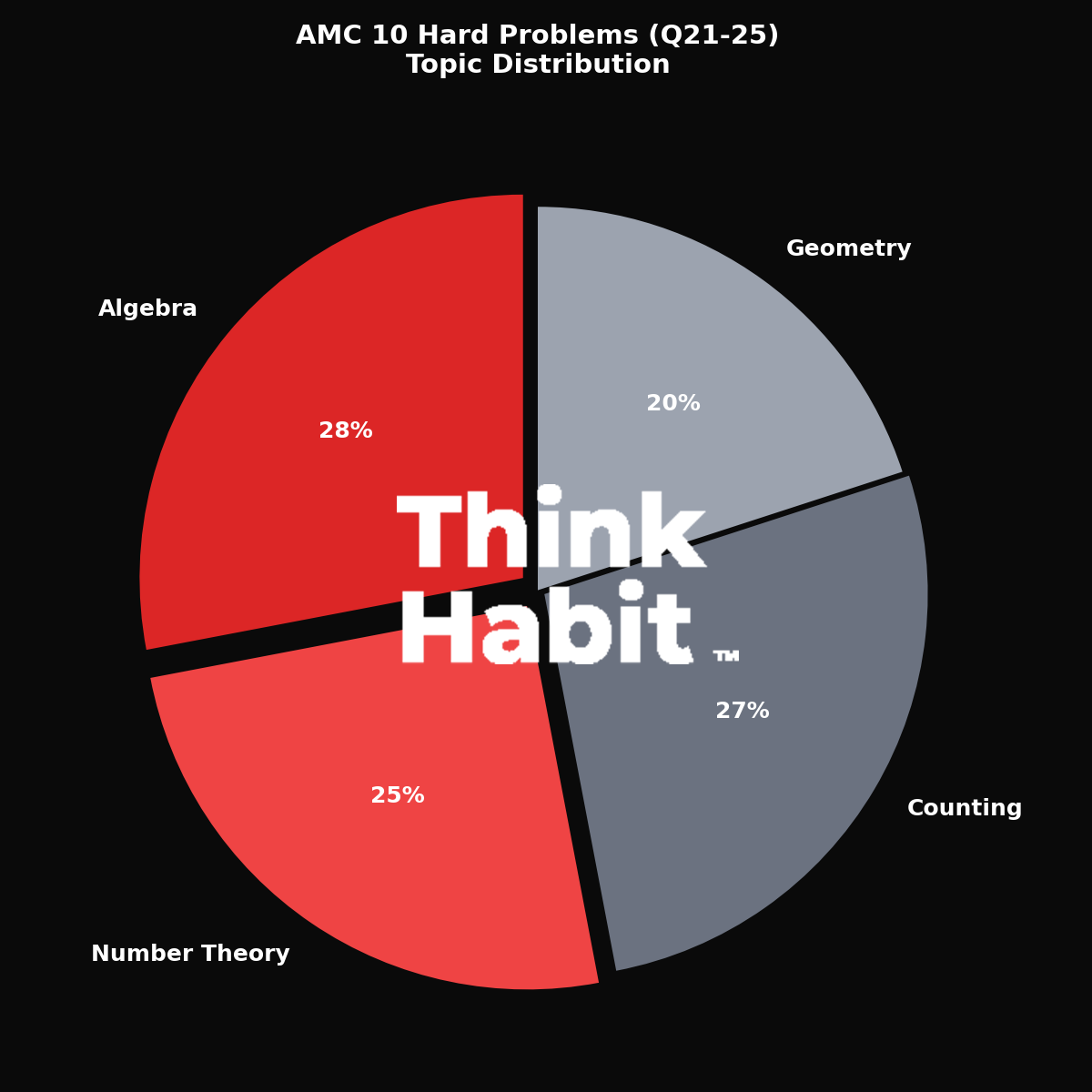
| Topic | Hard Problem % |
|---|---|
| Algebra | 28% |
| Counting | 27% |
| Number Theory | 25% |
| Geometry | 20% |
Unlike AMC 8 where geometry dominates hard problems, AMC 10 hard problems are evenly distributed.
This means you can't afford to be weak in any area. A single topic weakness could cost you 1-2 hard problems—enough to miss the AIME cutoff.
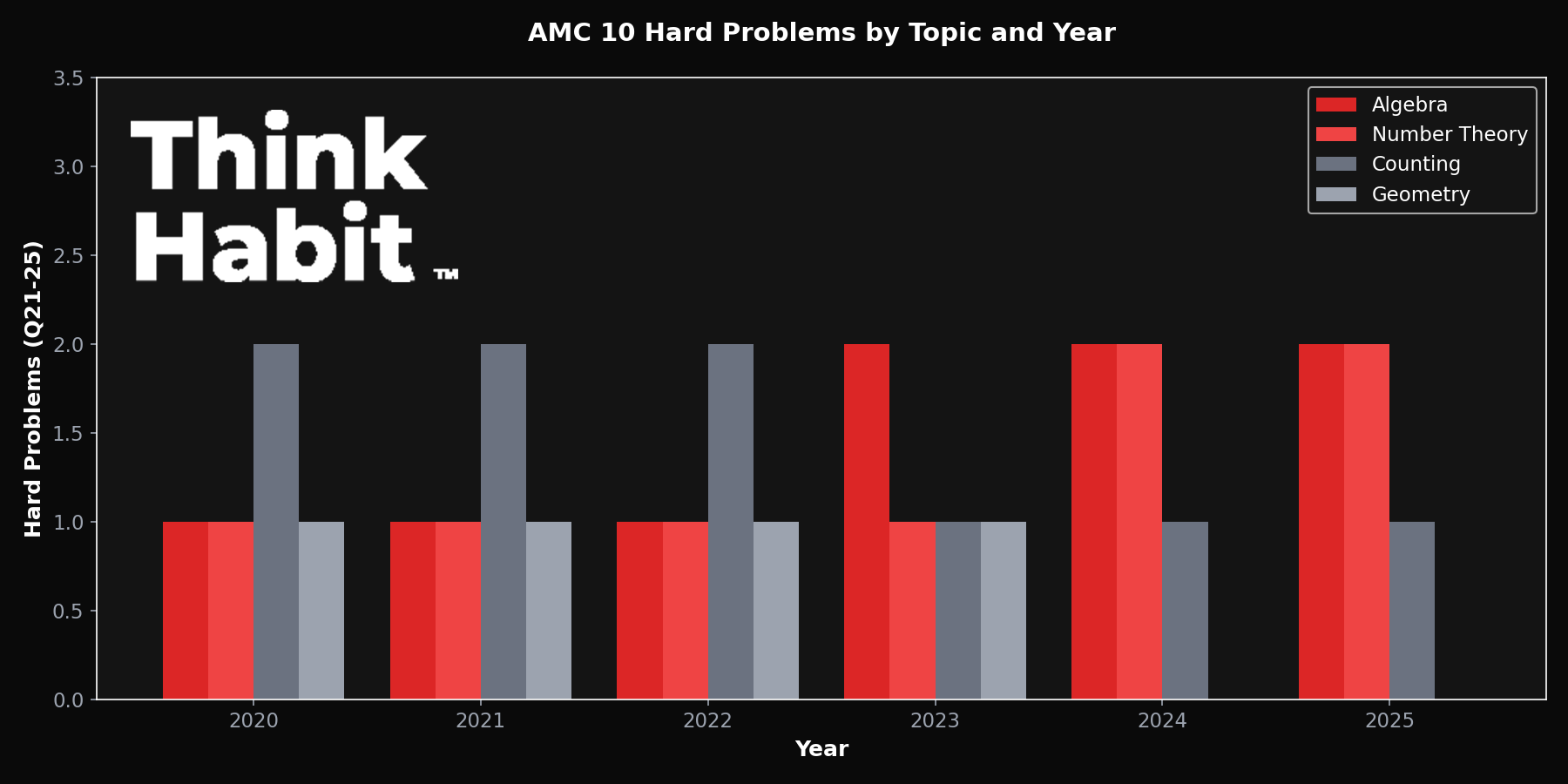
Recent trend: Algebra and Number Theory are appearing more in Q21-25, while Geometry is declining in the hard section.
AIME Cutoff Trends
What score do you need to qualify for AIME?
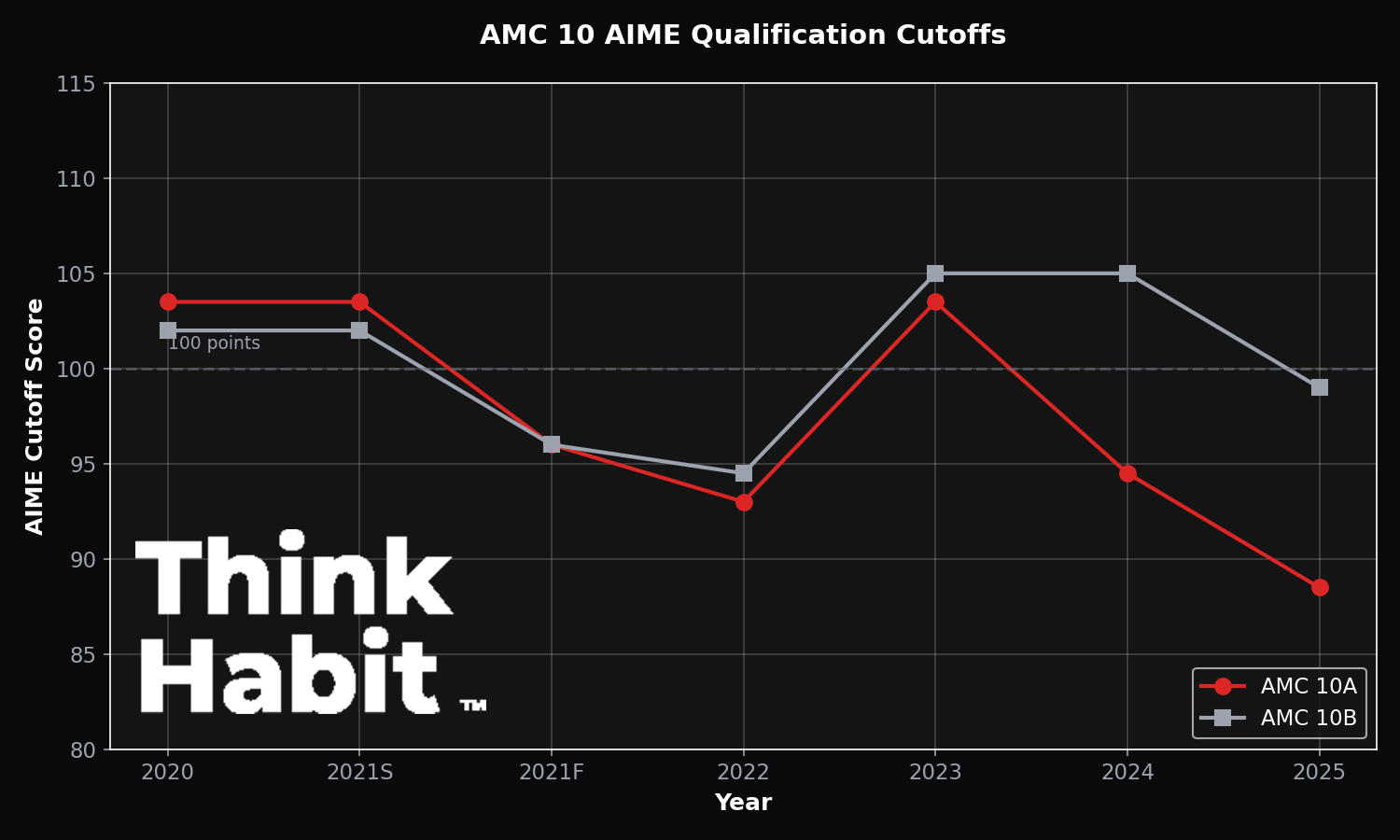
| Year | AMC 10A | AMC 10B |
|---|---|---|
| 2020 | 103.5 | 102 |
| 2021 (Spring) | 103.5 | 102 |
| 2021 (Fall) | 96 | 96 |
| 2022 | 93 | 94.5 |
| 2023 | 103.5 | 105 |
| 2024 | 94.5 | 105 |
| 2025 | 88.5 | 99 |
Key insights:
- Cutoffs are volatile, ranging from 88.5 to 105
- 10A and 10B can differ by 10+ points
- Taking both A and B doubles your chances
- Average cutoff is around 100 (roughly 14 correct + 4 blank)
2024 Awards (for reference):
| Award | AMC 10A | AMC 10B |
|---|---|---|
| AIME Qualification | 94.5 | 105 |
| Distinction (Top 5%) | 105 | 114 |
| Honor Roll (Top 1%) | 132 | 138 |
How to Prepare: Topic-by-Topic
Based on the data, here's how to prioritize.
Priority 1: Algebra (42% of test)
This is non-negotiable. You must be fast and accurate.
Key subtopics:
- Quadratic equations and factoring
- Systems of equations
- Functions and graphs
- Sequences (arithmetic, geometric)
- Inequalities
- Polynomials
How to train:
- AoPS Introduction to Algebra + Intermediate Algebra
- AMC 10 past problems sorted by topic
- Focus on speed drills—algebra problems should be automatic
Priority 2: Number Theory (22%, RISING)
The highest-ROI topic to study. Most competitors are weak here.
Key subtopics:
- Modular arithmetic (remainders, congruences)
- Prime factorization and divisibility
- GCD/LCM applications
- Number bases
- Diophantine equations
- Digit problems
How to train:
- AoPS Introduction to Number Theory (essential)
- Practice converting between bases
- Master mod arithmetic through repetition
- AMC 10/12 number theory problem sets
Priority 3: Counting & Probability (20%)
Consistent and predictable. Systematic methods win.
Key subtopics:
- Combinations and permutations
- Complementary counting
- Casework
- Expected value
- Probability with conditions
How to train:
- AoPS Introduction to Counting & Probability
- Practice "no gaps, no overlaps" counting
- Work on problems requiring multiple techniques
Priority 4: Geometry (16%)
Still important, but less dominant than in AMC 8.
Key subtopics:
- Similar triangles and ratios
- Circles (inscribed angles, power of a point)
- Coordinate geometry
- 3D visualization
- Area methods
How to train:
- AoPS Introduction to Geometry
- Focus on problems combining multiple concepts
- Learn coordinate bash as a backup technique
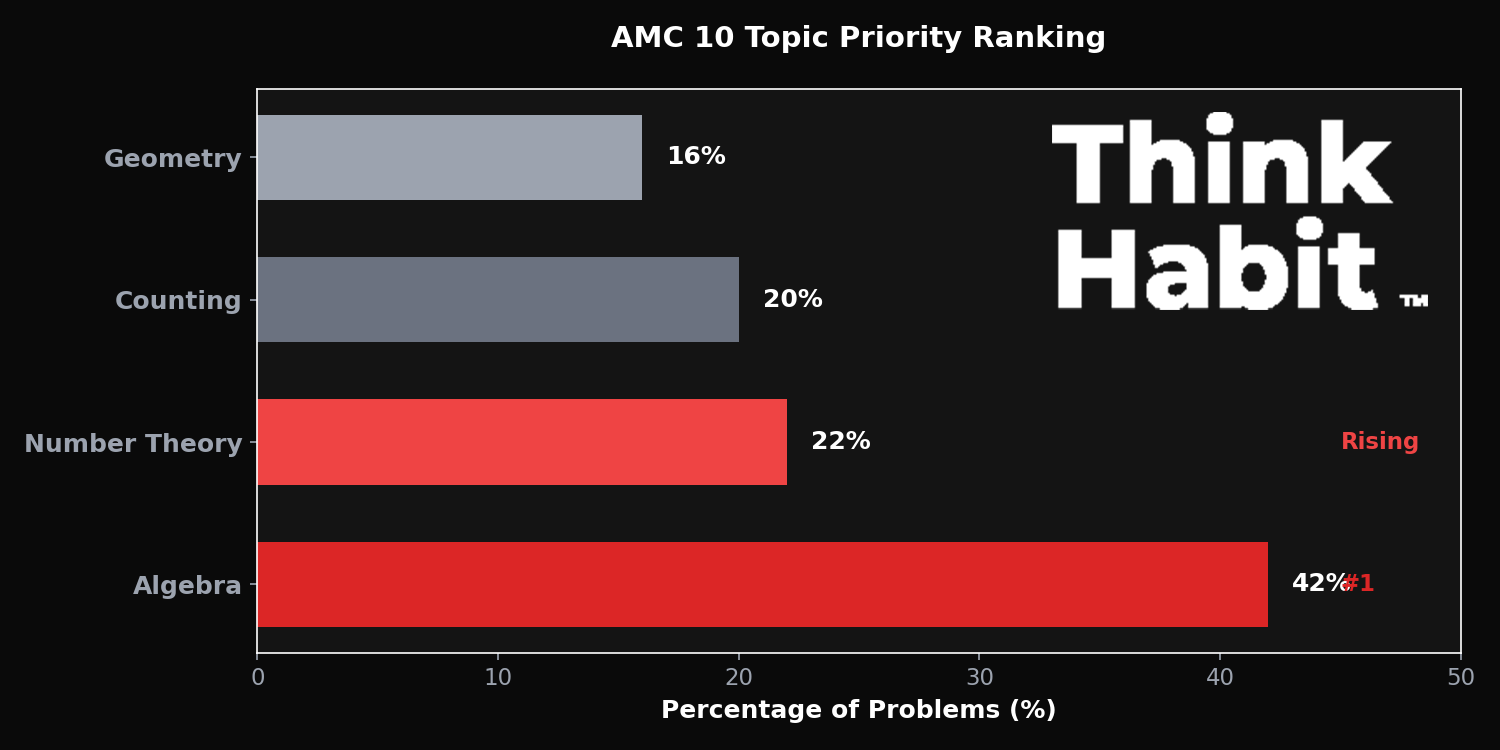
Topic Ranking at a Glance
![amc10_topic_ranking.png]
AMC 10 vs AMC 8: Key Differences
If you're transitioning from AMC 8:
| Aspect | AMC 8 | AMC 10 |
|---|---|---|
| Top Topic | Geometry (22%) | Algebra (42%) |
| Rising Topic | Number Theory | Number Theory |
| Hard Problems | Geometry-heavy | Evenly distributed |
| Time Pressure | Moderate | High |
| Required Level | Pre-Algebra + | Algebra 2 level |
The biggest shift: AMC 8 rewards geometry specialists. AMC 10 requires balanced mastery across all topics.
Strategic Recommendations
For AIME Qualification (Score ~100+)
- Master Q1-15 first. These should be nearly automatic. Target 14-15 correct.
- Get 2-3 from Q16-20. This is where preparation shows.
- Attempt 1-2 from Q21-25. Even partial progress helps.
- Leave strategic blanks. Wrong answers cost 0.5 points.
For Distinction (Score ~110+)
- Q1-15 must be perfect or near-perfect.
- Get 4-5 from Q16-20.
- Solve 2-3 from Q21-25.
- Time management is critical. Practice under test conditions.
For Honor Roll (Score ~135+)
- Near-perfect on Q1-20.
- Solve 3-4 from Q21-25.
- This requires deep mastery across all topics.
- AIME-level problem practice is essential.
The Bottom Line
AMC 10 is harder than AMC 8, but the data shows clear priorities:
- Algebra is king. 42% of the test. No shortcuts here.
- Number Theory is rising fast. From 12% to 22%. Study it separately.
- Hard problems are balanced. You can't have weak areas.
- Take both A and B. Cutoffs vary significantly.
- Speed matters. 75 minutes for 25 problems is tight.
Stop studying randomly. Let the data guide your preparation.
Targeting AIME but not sure where you stand? Drop a comment with your recent practice test score and I'll help you build a targeted study plan.