AMC 8 Data Analysis: 10 Years of Problems Exposed
If you're preparing for AMC 8 by "just working hard," stop for a second.
I analyzed every single problem from 2016 to 2025. That's 225 problems across 9 years, classified by topic. What shows up most? What makes the hard problems hard? What's changed recently? The data tells a very different story than most prep advice.
The Big Picture: What Shows Up Most?
Let's start with the overall distribution across all 225 problems.
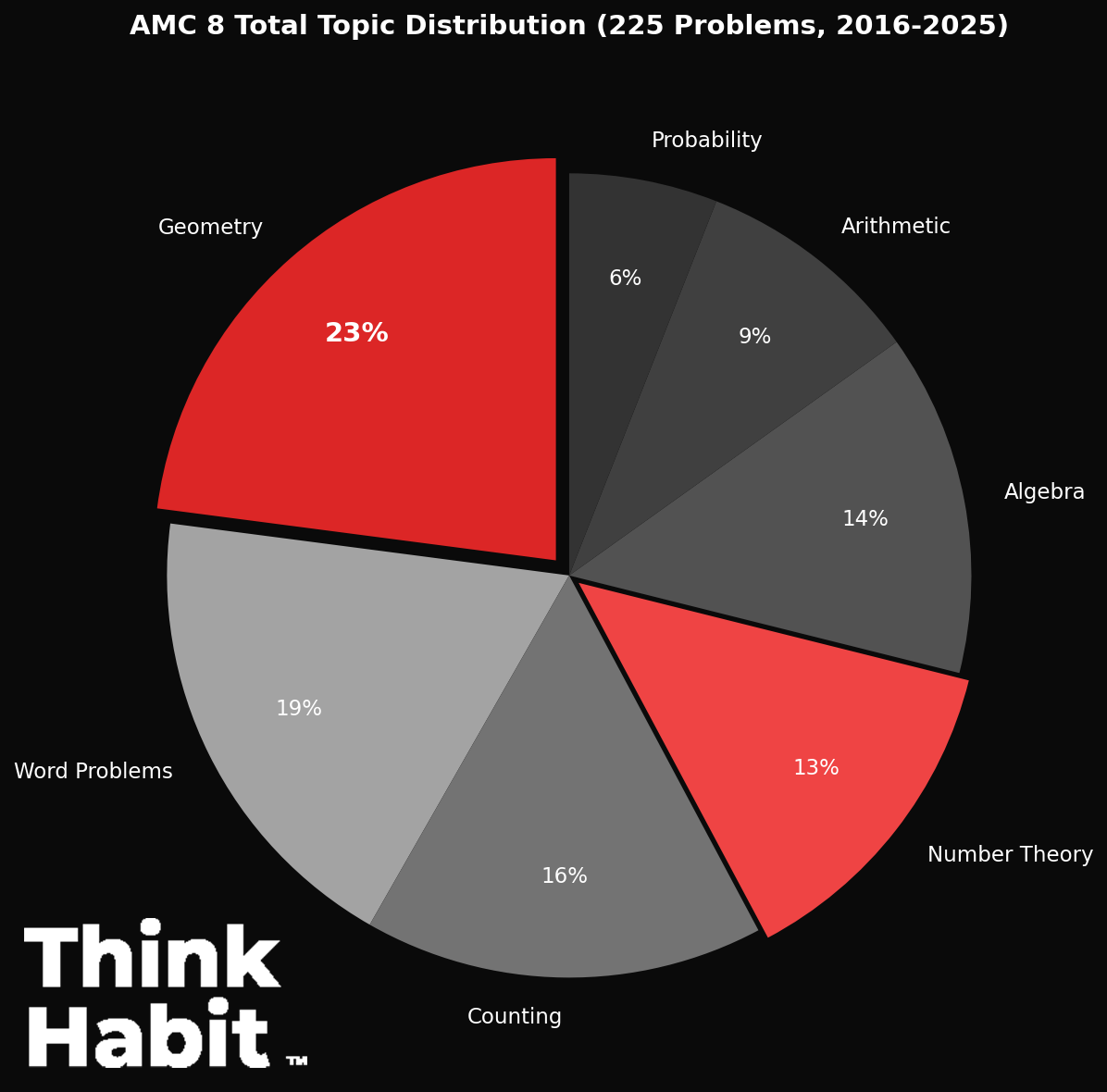
Here are the numbers:
| Rank | Topic | Problems | Percentage |
|---|---|---|---|
| 1 | Geometry | 50 | 22% |
| 2 | Word Problems | 41 | 18% |
| 3 | Counting | 35 | 16% |
| 4 | Number Theory | 29 | 13% |
| 5 | Algebra | 30 | 13% |
| 6 | Arithmetic | 20 | 9% |
| 7 | Probability | 13 | 6% |
The top 3 topics make up 56% of all problems. Geometry, word problems, counting. If you're weak in these areas, you're giving up more than half the test.
Year-by-Year: What's Changing?
Now let's look at how the distribution shifts each year.
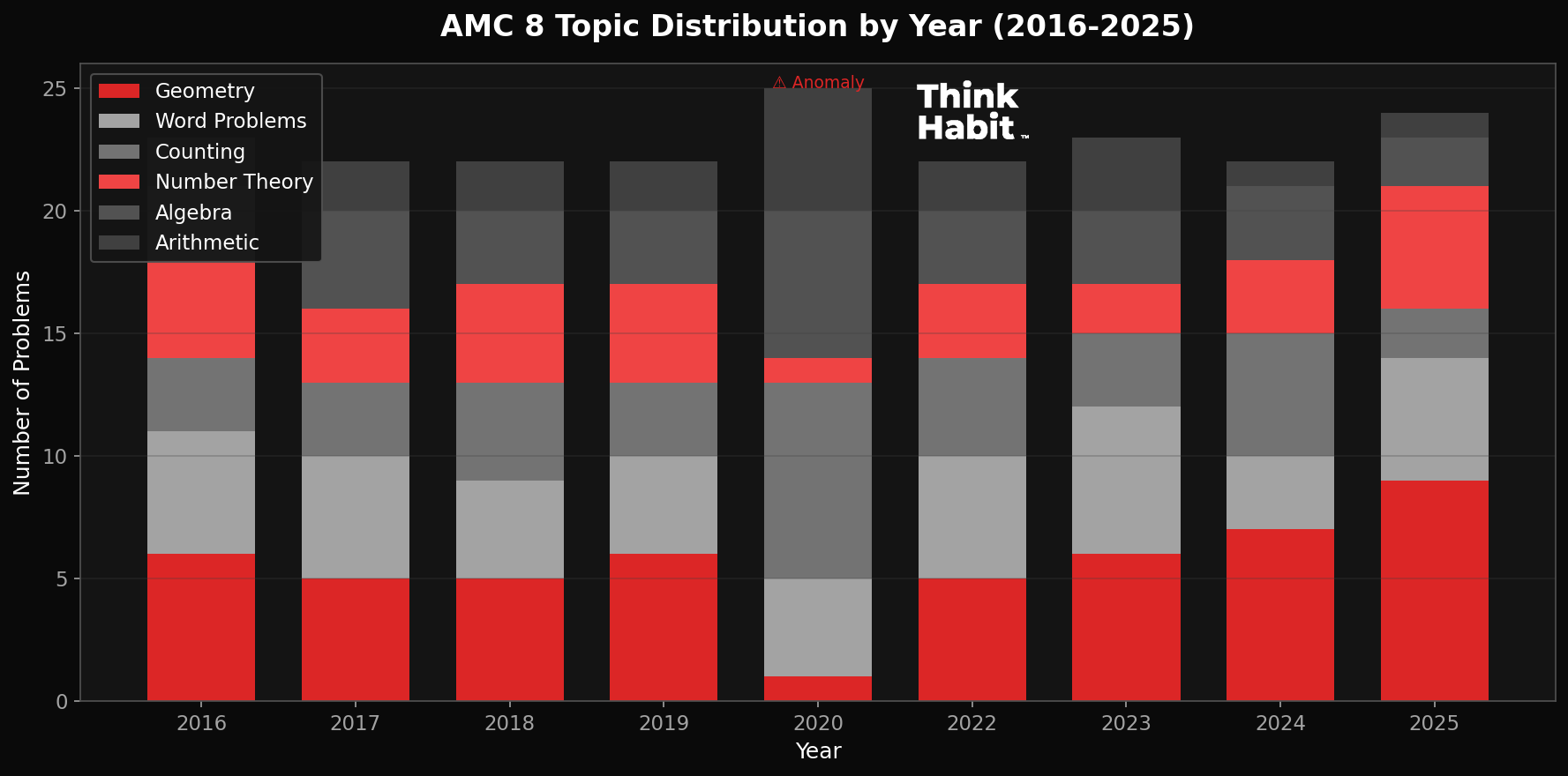
A few things jump out.
First, 2020 is an anomaly. Only 1 geometry problem that year. Normally there are 5-6. Counting exploded to 8 problems. This was likely due to the unusual circumstances of that year. Don't use 2020 as a reference for trends.
Second, geometry has surged since 2023. It went from 6 problems to 7 to 9. In 2025, 9 out of 25 problems were geometry. That's 36% of the entire test.
Third, number theory is rising. From 2 problems in 2023 to 5 in 2025. This is a topic most schools barely cover, so you need to study it separately.
The Real Game: Hard Problems
If you're aiming for Honor Roll, Q1-20 is just the baseline. The real competition happens in Q21-25.
So I classified just those 45 hard problems across 9 years.
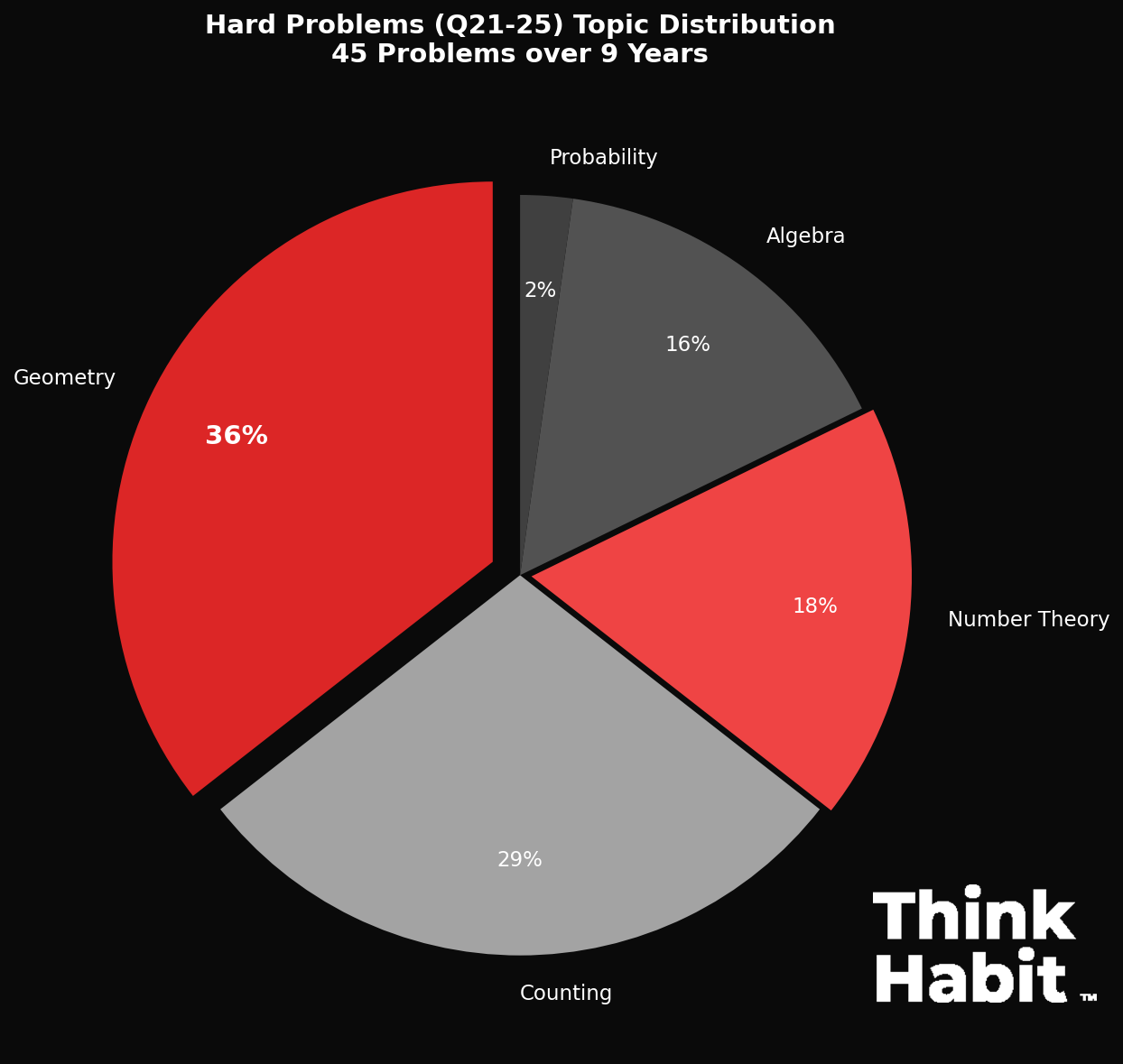
| Topic | Problems | Percentage |
|---|---|---|
| Geometry | 16 | 36% |
| Counting | 13 | 29% |
| Number Theory | 8 | 18% |
| Algebra | 7 | 16% |
| Probability | 1 | 2% |
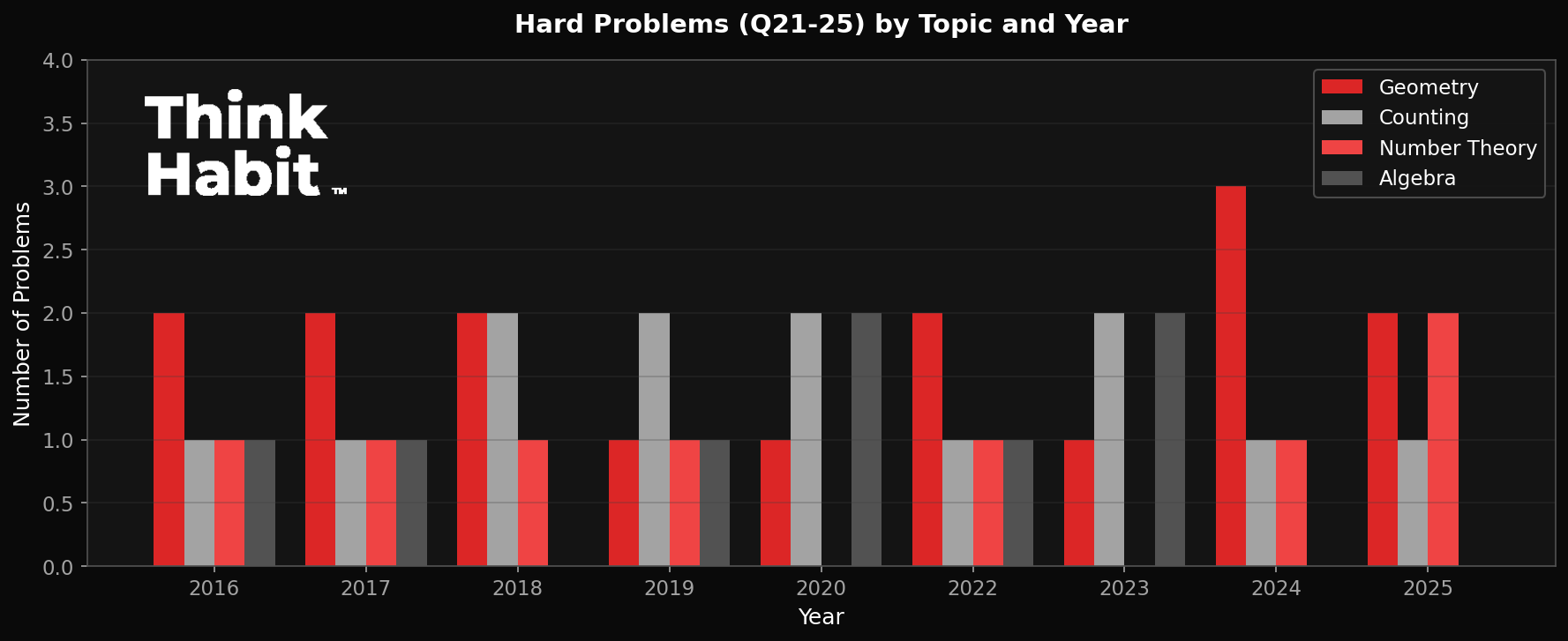
65% of hard problems are geometry + counting.
If you can't solve hard geometry, Honor Roll is basically impossible. In 2024, 3 out of 5 hard problems were geometry. That's 60%.
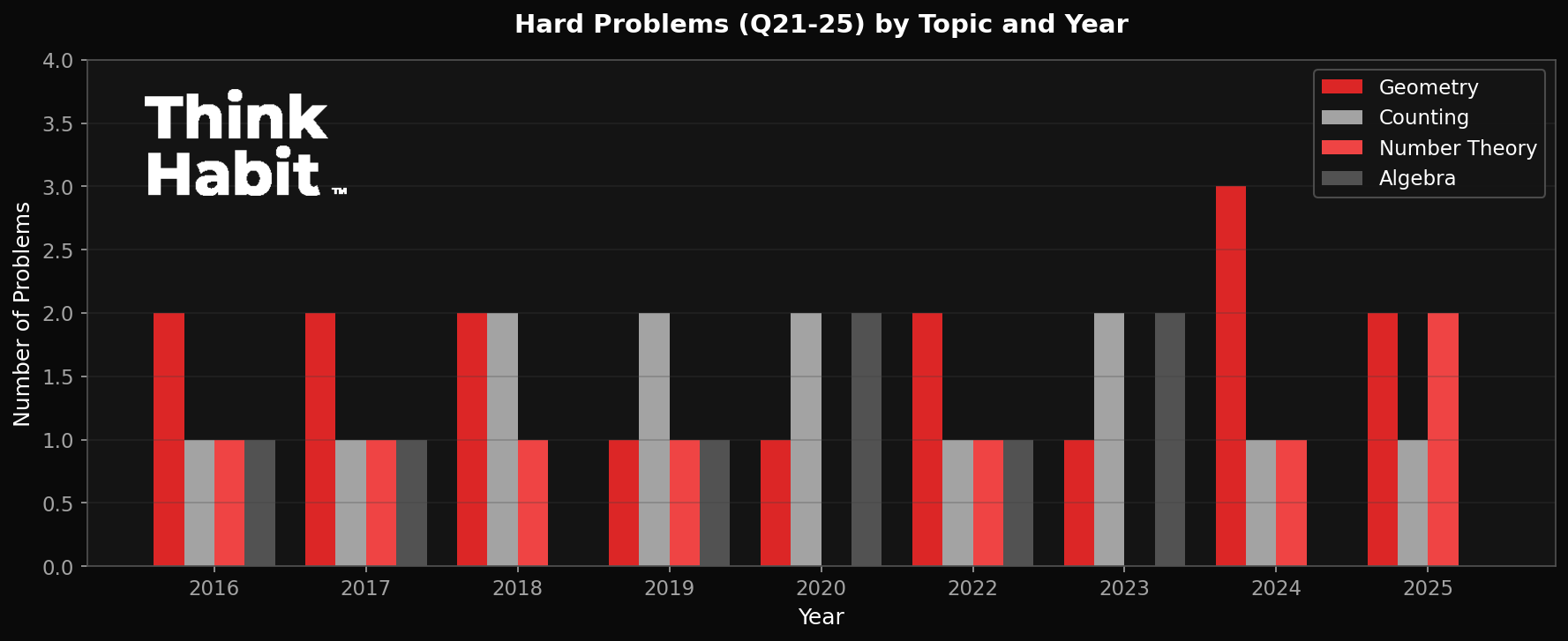
Looking at it year by year, geometry (red) appears in the hard section almost every single year. Counting is consistent too.
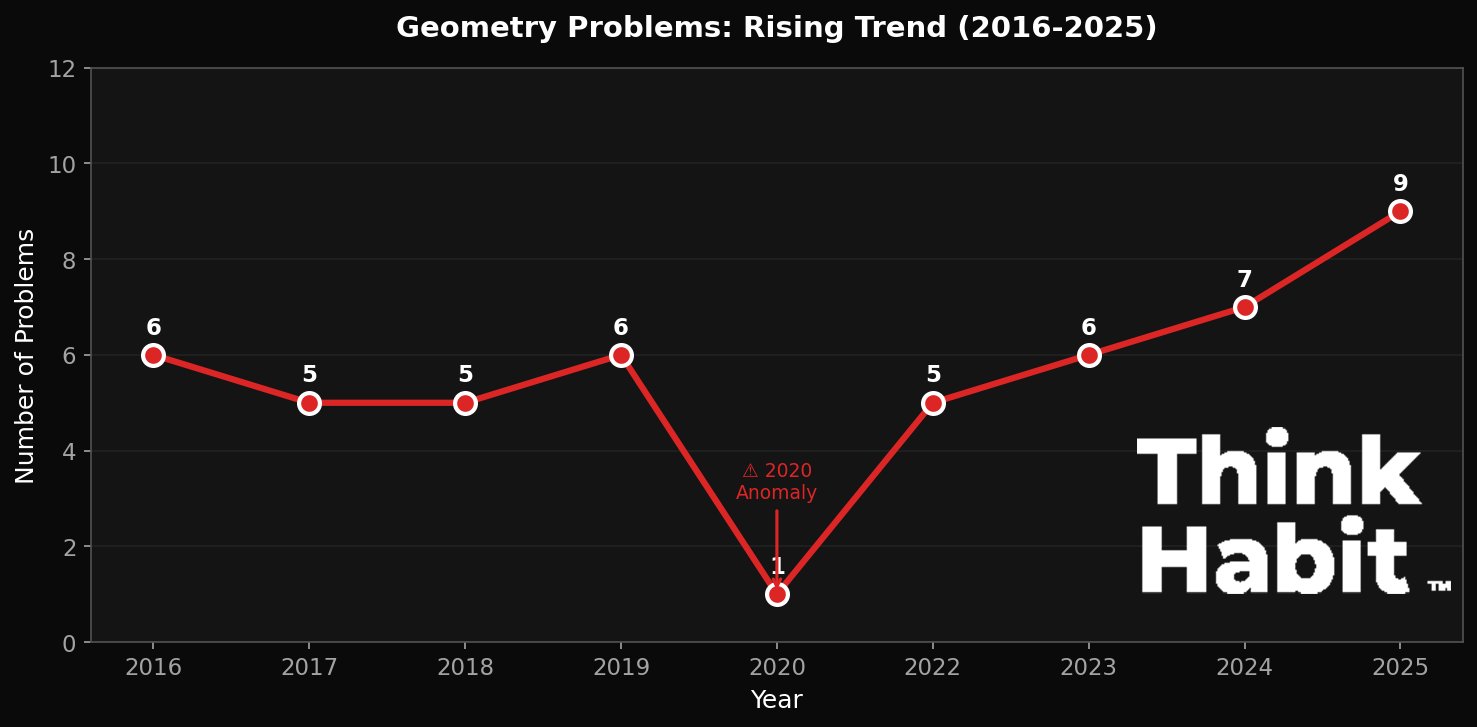
Geometry Trend: Is It Really Rising?
Yes. Definitively.
![amc8_geometry_trend.png]
From 2016-2019, geometry stayed around 5-6 problems. Then 2024 hit 7, and 2025 hit 9. The only dip was 2020's anomaly, and it bounced right back.
Expect this trend to continue into 2026. Make geometry your top priority.
Score Statistics: What's the DHR Cutoff?
For reference, here are the score cutoffs over the years.
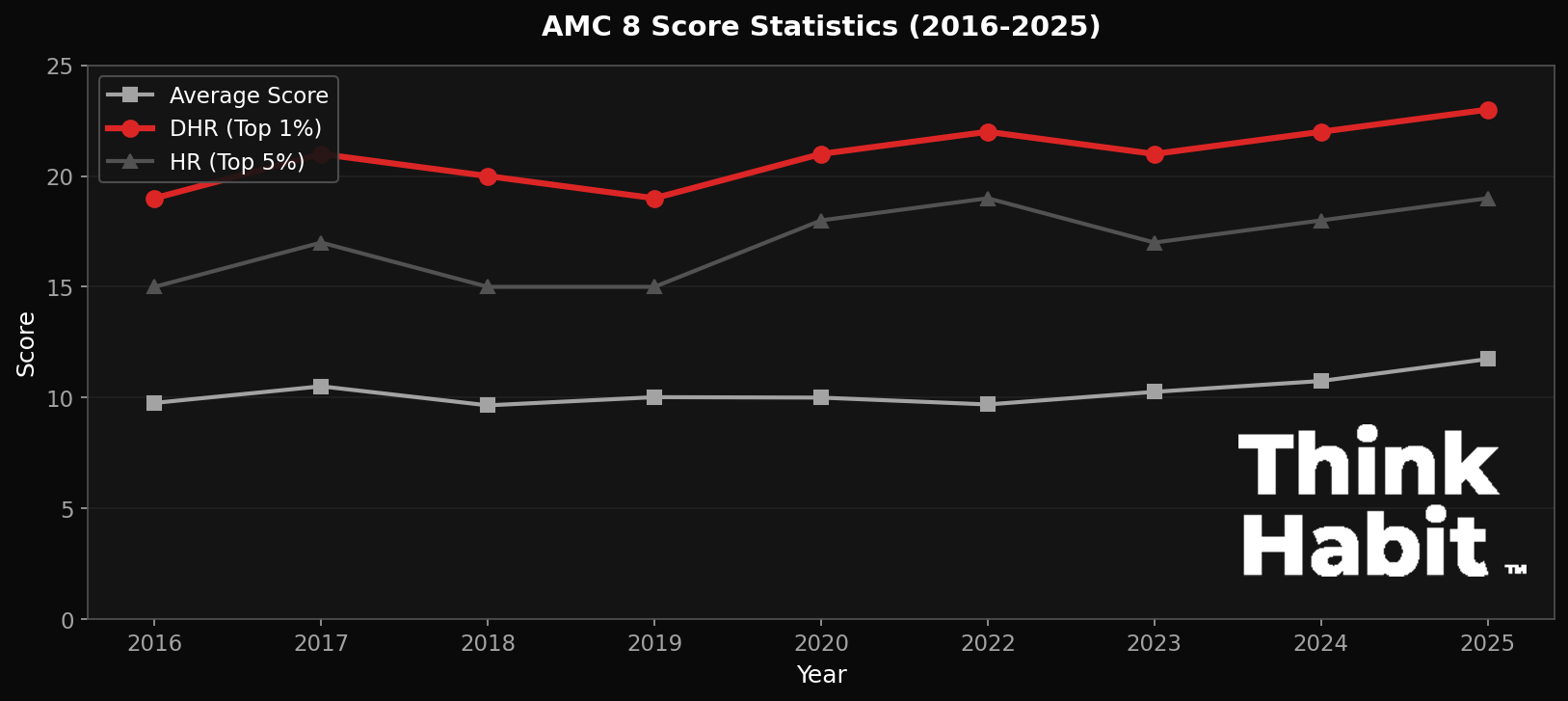
| Year | Average | DHR (Top 1%) | HR (Top 5%) |
|---|---|---|---|
| 2020 | 10.00 | 21 | 18 |
| 2022 | 9.69 | 22 | 19 |
| 2023 | 10.26 | 21 | 17 |
| 2024 | 10.75 | 22 | 18 |
| 2025 | 11.74 | 23 | 19 |
The 2025 DHR cutoff was 23—the highest ever. Average score also jumped to 11.74. Whether the test got easier or test-takers got better, the bar for DHR is now near-perfect performance.
So How Should You Prepare?
The data points to a clear strategy.
Priority 1: Geometry
22% of all problems. 36% of hard problems. This is non-negotiable.
Key subtopics:
- Area of composite figures
- Pythagorean theorem applications
- Similar triangles and area ratios
- Inscribed/circumscribed circles
- Basic coordinate geometry
How to train:
- AMC 10 geometry Q1-15 (similar difficulty to AMC 8 Q21-25)
- AoPS Introduction to Geometry, Chapters 1-8
- Collect past AMC 8 geometry problems from Q16-25 and find patterns
Priority 2: Counting
29% of hard problems. You need systematic methods, not guessing.
Key subtopics:
- Organized casework
- Complementary counting
- Path counting on grids
- Basic permutations and combinations
How to train:
- AoPS Introduction to Counting & Probability, Chapters 1-6
- Practice "no missing, no duplicates" counting
- Start with small examples, find patterns, then generalize
Priority 3: Number Theory
Rising fast. Most schools don't teach this properly.
Key subtopics:
- Divisibility rules (2, 3, 4, 5, 6, 9, 11)
- Prime factorization
- GCD and LCM
- Modular arithmetic basics
- Digit problems
How to train:
- AoPS Introduction to Number Theory, Chapters 1-5
- Experiment with small numbers to find patterns
- Extend to AMC 10 number theory problems
The Rest
Word problems and algebra appear consistently but aren't dominant in the hard section. Solid fundamentals are enough.
Probability and pure arithmetic are declining. Lower your priority on these.
Topic Ranking at a Glance
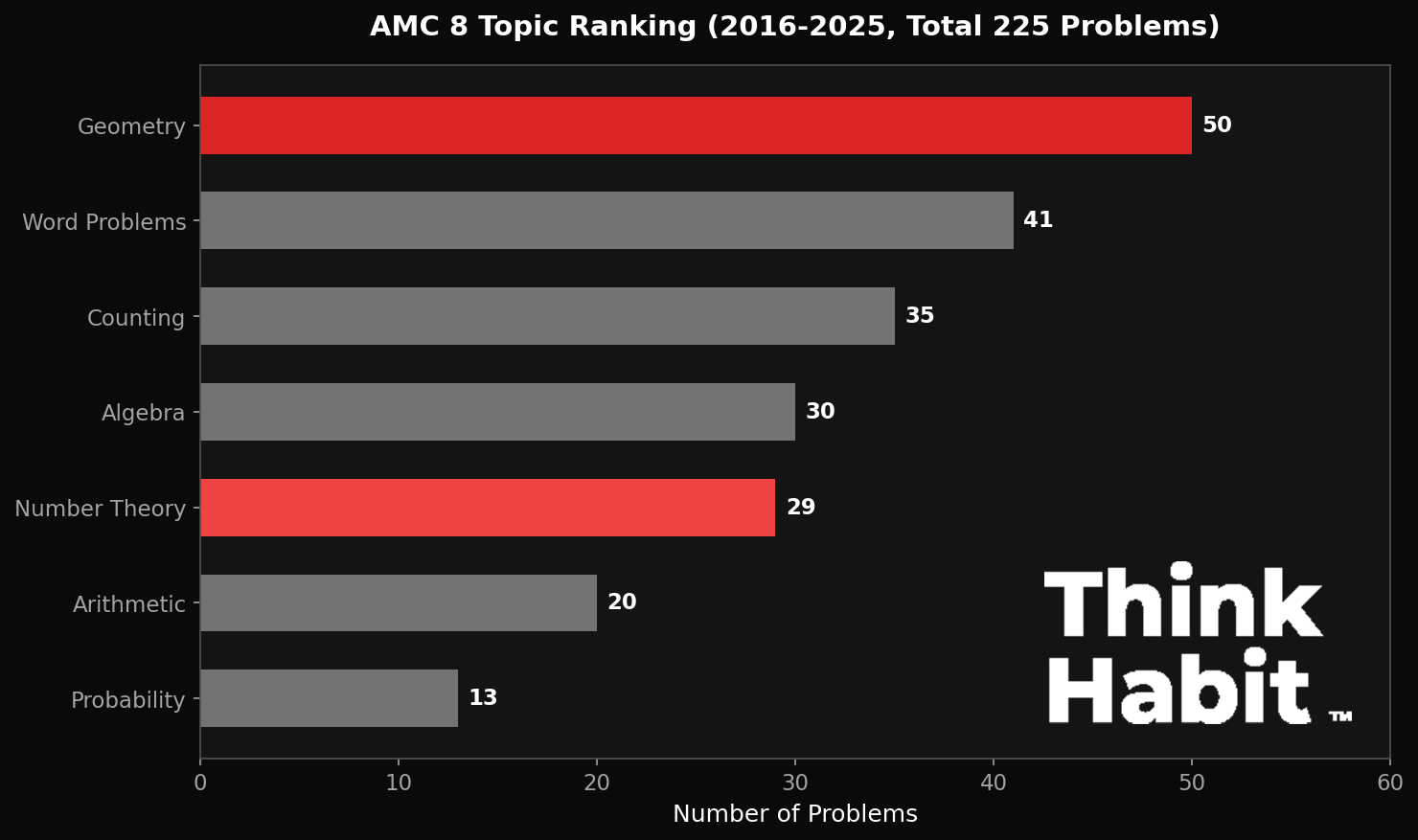
Red marks what matters most. Geometry is the clear #1. Number theory is the rising star.
The Bottom Line
AMC 8 isn't about working hard. It's about working smart.
What the data says:
- Master geometry. 22% of all problems, 36% of hard problems.
- Learn counting systematically. 29% of hard problems.
- Add number theory. Rising fast, not taught in school.
- Use AMC 10 to level up. AMC 8 Q21-25 ≈ AMC 10 Q1-15.
Stop preparing blindly. Let the data guide you.
Not sure where you're weak? Drop a comment with your recent practice test score and which problems you missed. I'll help you analyze it from a Think-Habit perspective.