What Is AIME and Why It Matters in the Age of AI

If your child qualified for AIME, congratulations. That's a real achievement.
But you might be wondering: what exactly is this test? How hard is it? And in a world where AI can solve most math problems instantly, why does any of this matter?
Let me break it down.
What Is AIME?
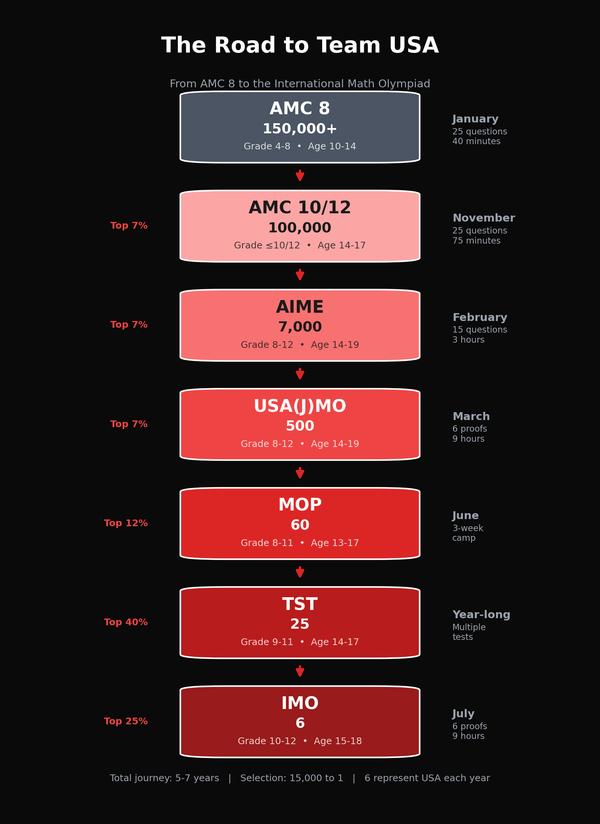
AIME stands for American Invitational Mathematics Examination. It's the second round of the AMC competition series, after AMC 10 and AMC 12.
Here are the basics:
15 questions. 3 hours. No multiple choice.
Every answer is an integer from 000 to 999. You either get it exactly right, or you get zero. There's no partial credit, no "close enough."
The test happens in February, and there are two versions: AIME I and AIME II. Students take one or the other, not both.
Who Takes AIME?
You can't just sign up. You have to earn your way in.
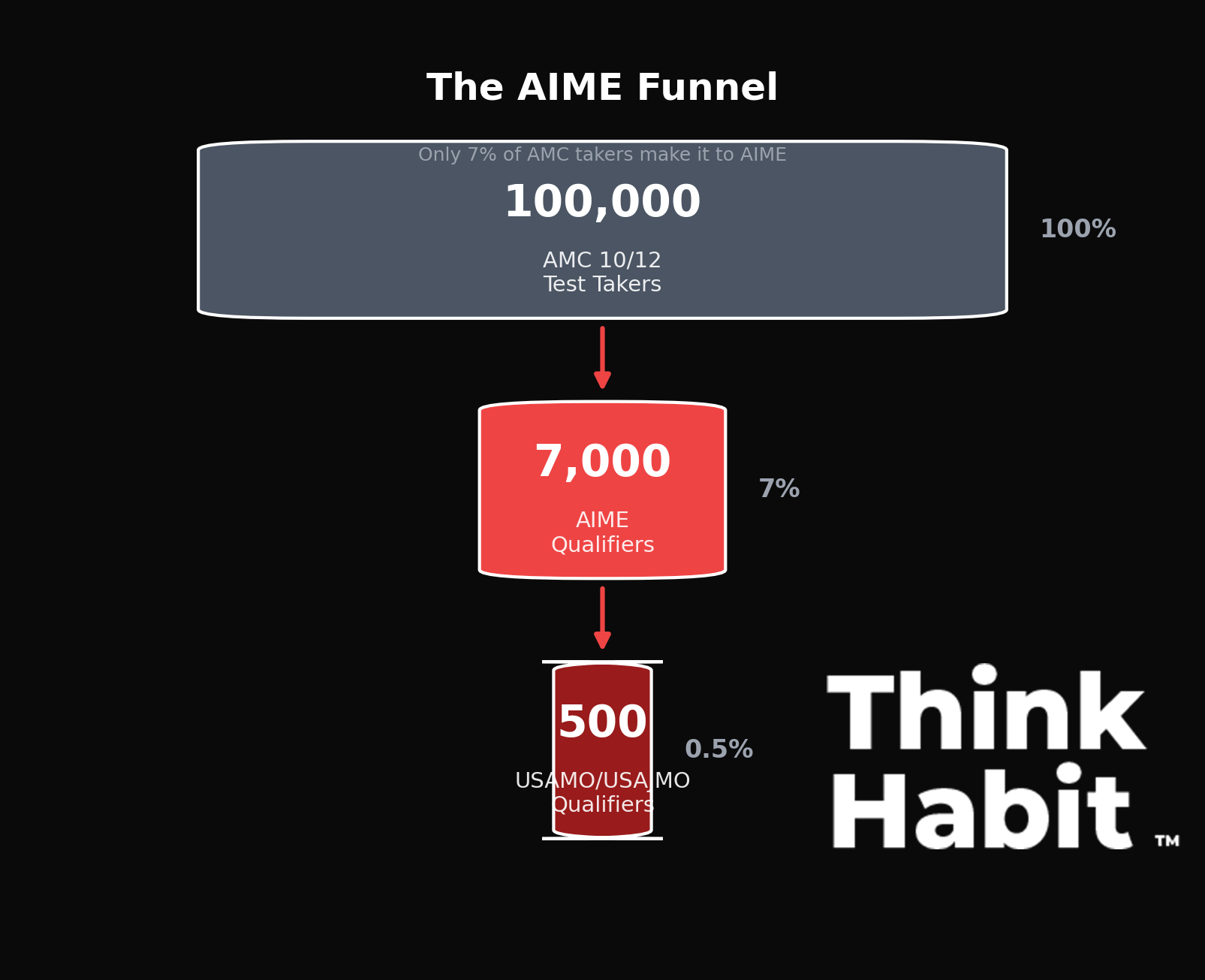
Roughly the top 2.5% of AMC 10 takers and the top 5% of AMC 12 takers get invited. In practice, that means scoring around 90-105 on AMC 10 or 80-90 on AMC 12, though the cutoffs change every year.
About 6,000 to 7,000 students qualify annually. That sounds like a lot, but remember, over 100,000 take the AMC. Making AIME already puts you in a pretty select group.
How Hard Is It?
Let me be honest. AIME is hard.
The problems look deceptively simple. They're stated in a few sentences. But solving them is a different story.
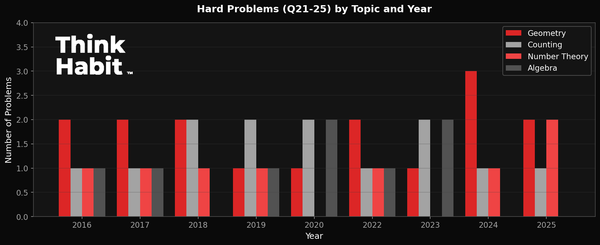
A typical AIME problem might combine geometry with number theory. Or algebra with combinatorics. Or all four at once. You can't just apply a formula you memorized. You have to figure out what's really going on, find connections between different ideas, and build a solution from scratch.
Most first-timers find themselves stuck on problem 1 or 2. That's normal. Even the "easy" problems require real thought.
Here's a rough sense of the levels:
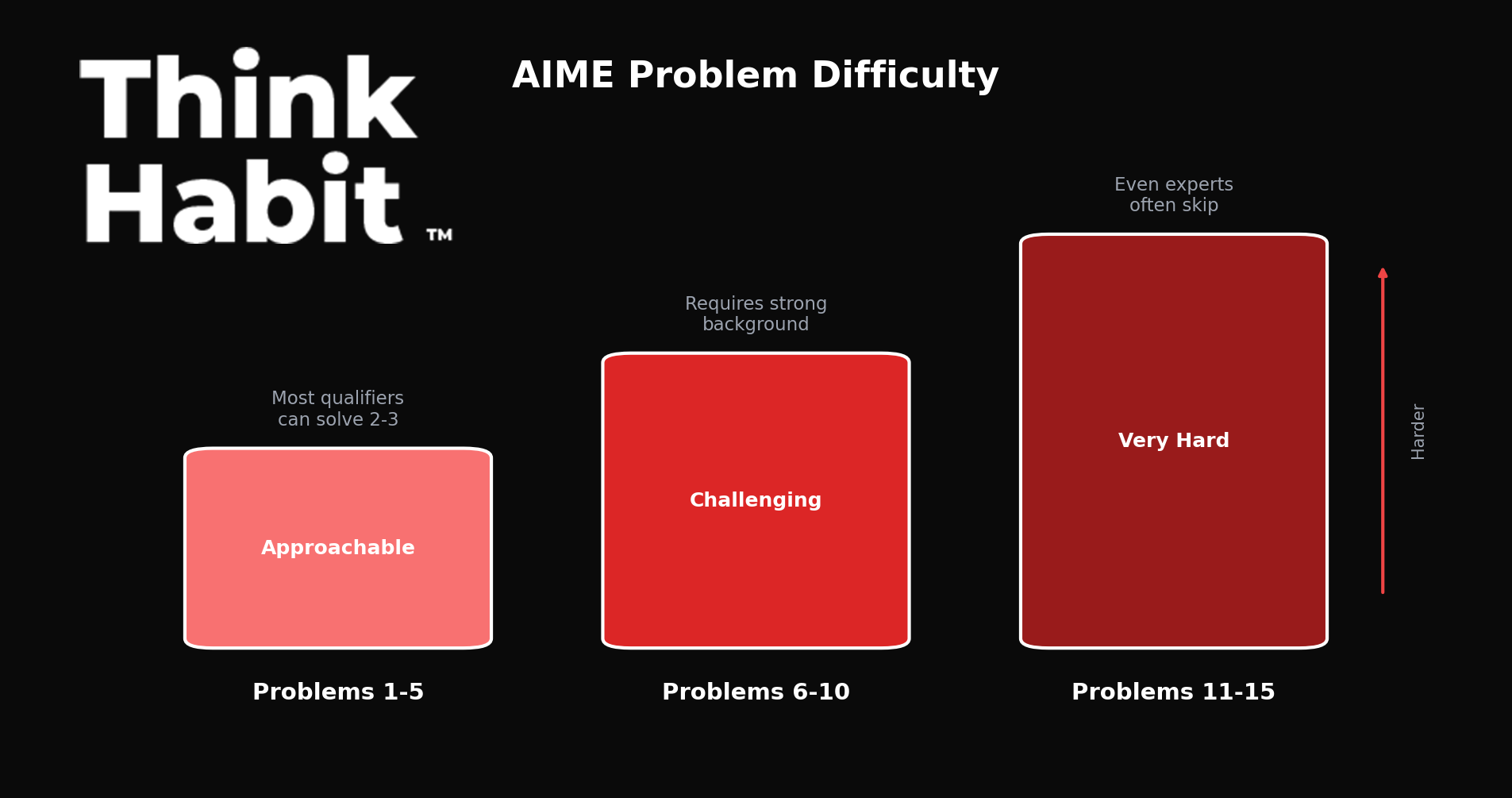
Problems 1-5: Challenging but doable if you've practiced. Most AIME qualifiers can solve a few of these.
Problems 6-10: Requires solid competition math background. This is where most students hit a wall.
Problems 11-15: Very difficult. Even experienced competitors often leave these blank.
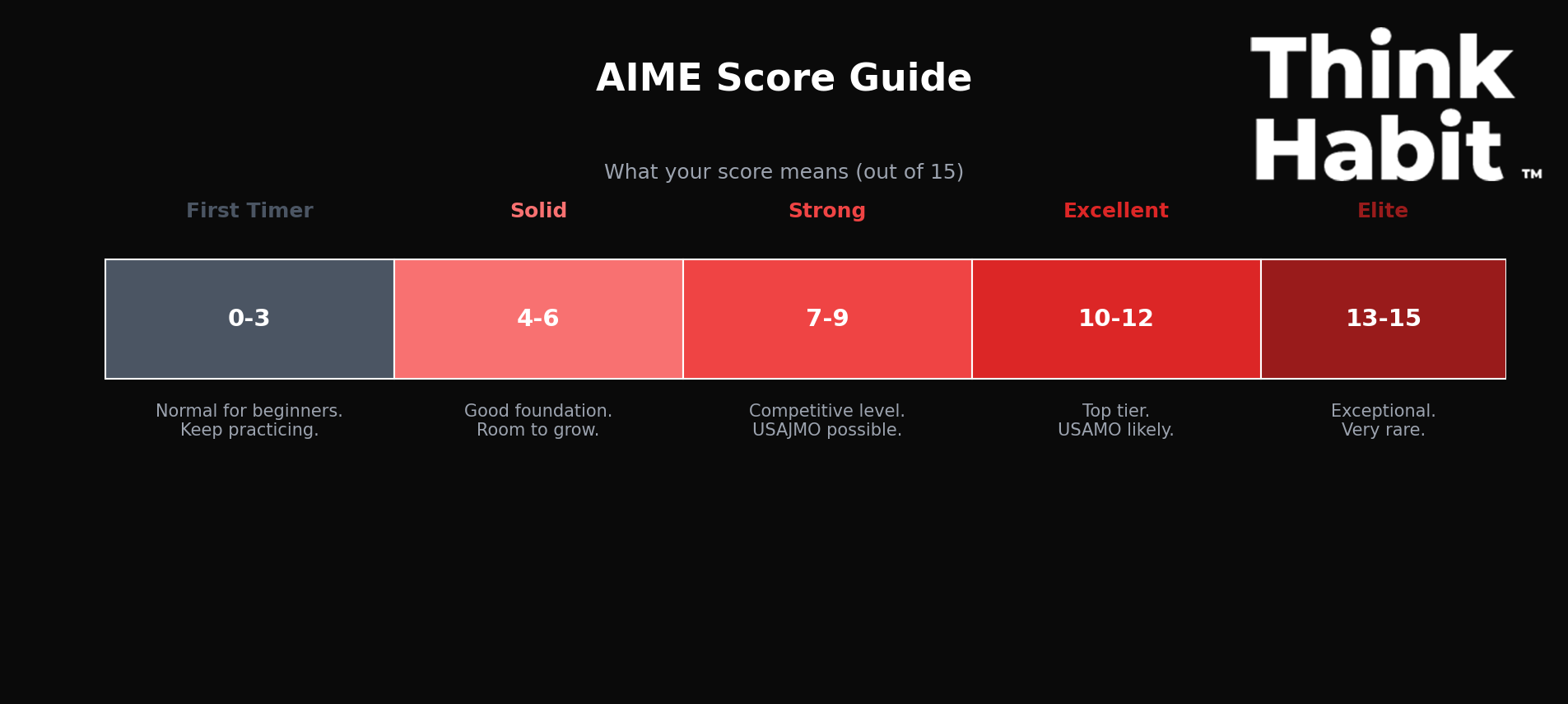
A score of 5 or 6 out of 15 is respectable for a first-timer. A score of 10+ is exceptional.
How Do You Prepare?
No shortcut here. You have to solve a lot of problems.
Start with past AIME exams. There are decades of them available online, for free. Work through them without time pressure at first. Understand the solutions deeply, even for problems you got right.
Four areas to focus on:
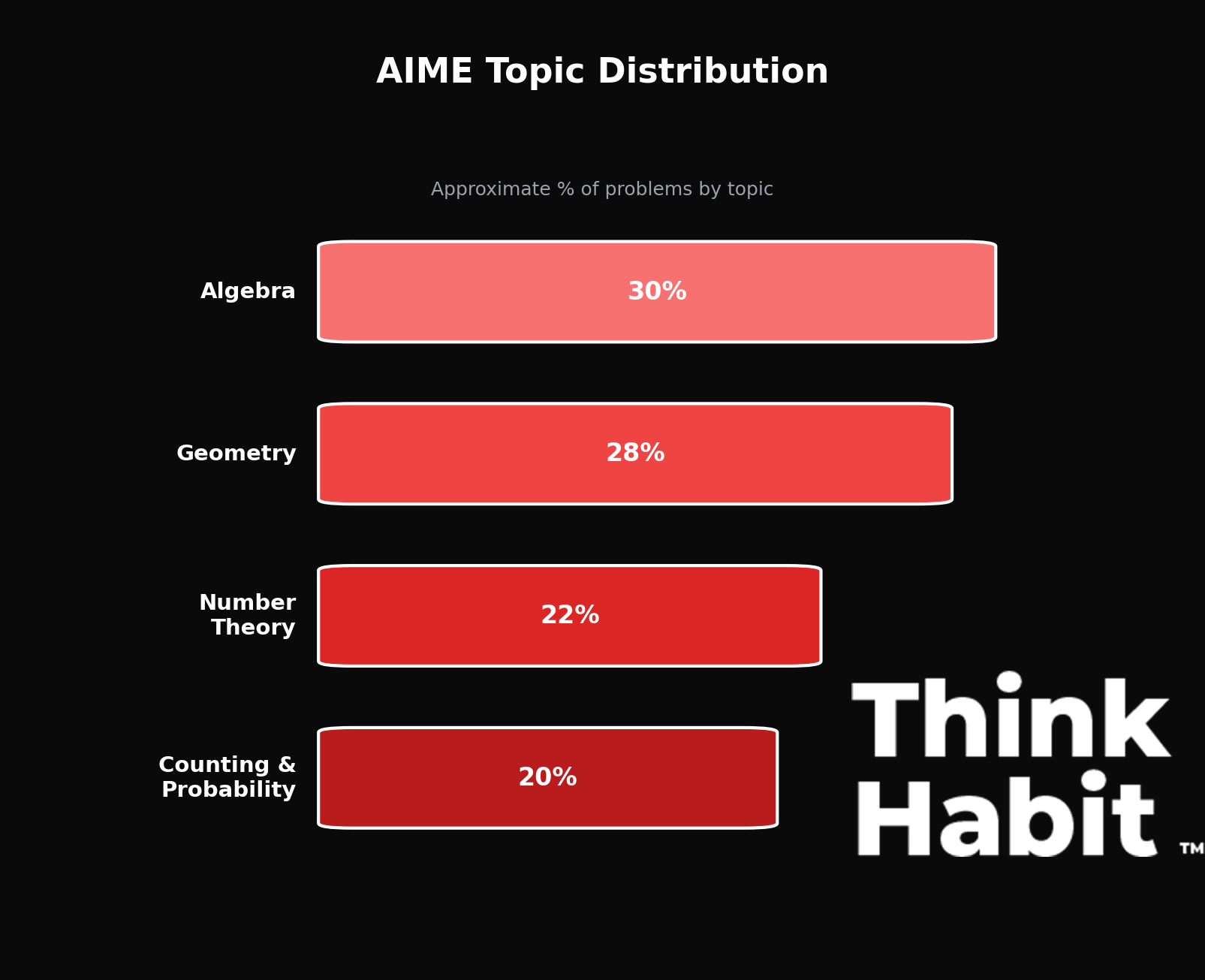
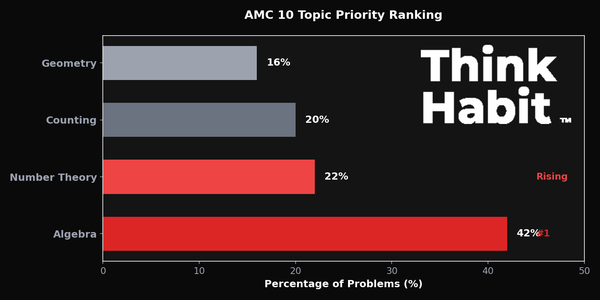
Algebra. Polynomials, equations, inequalities, sequences. AIME loves clever manipulations.
Geometry. Triangles, circles, coordinates, 3D shapes. Know the standard theorems cold and learn to combine them creatively.
Number Theory. Divisibility, modular arithmetic, prime factorization. Many school-taught students struggle here because it's rarely covered in regular classes.
Counting. Combinations, permutations, expected value, casework. These problems often require systematic thinking and careful organization.
Beyond content, develop problem-solving instincts. Learn to ask: what's the pattern here? Can I work backwards? Is there a simpler version I can solve first?
Books like Art of Problem Solving are excellent. So are online platforms like AoPS or Brilliant.
But really, there's no substitute for sitting with hard problems until something clicks.
What Does AIME Mean in the Age of AI?
This is what I find most interesting.
We live in a time when ChatGPT can solve most standard math problems. Give it an AMC question, it'll probably get it right. Even some AIME problems.
So what's the point?
Here's my take.
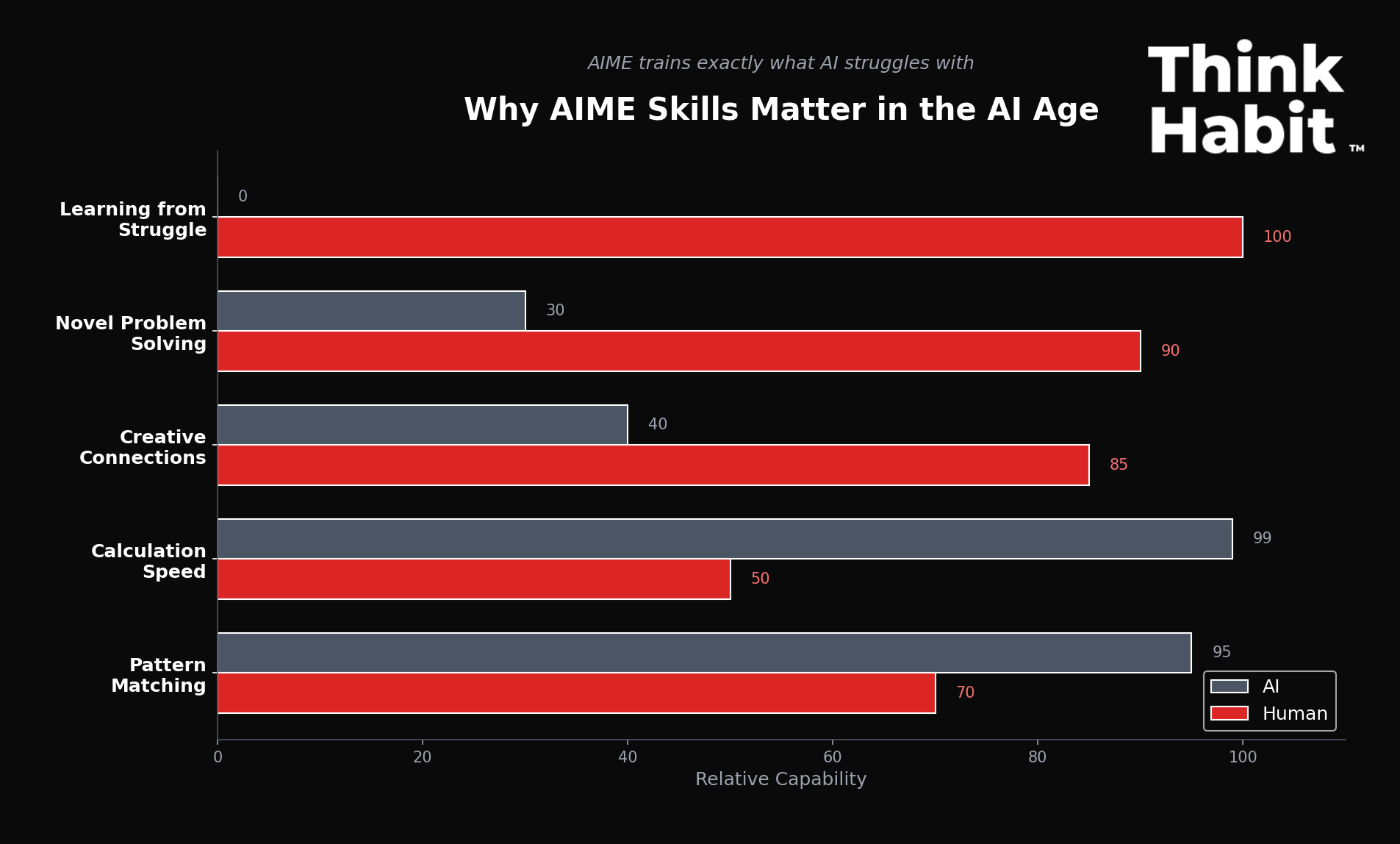
AI is very good at pattern matching. If it's seen a similar problem before, it can apply the same approach. That works for routine calculations.
But AIME problems aren't routine. They're designed to be unfamiliar. Each one is a little puzzle that requires you to notice something, make a connection, try an approach that might not work, backtrack, and try again.
This is exactly the kind of thinking that's hard to automate.
When a student spends an hour on a single problem, gets stuck, tries different angles, and finally breaks through, something happens in their brain. They're not just learning math. They're learning how to deal with situations where the path forward isn't obvious.
That skill, figuring out what to do when you don't know what to do, is precisely what the AI age demands.
The World Economic Forum lists analytical thinking and creative problem-solving as the top skills for the future. Not because they're nice to have. Because machines can't easily replicate them.
AIME trains exactly that.
The Bigger Picture
Making AIME is an accomplishment. But the score isn't really the point.
The point is what happens when you prepare. When you spend months pushing yourself on problems without obvious solutions. When you fail repeatedly and keep going. When you finally solve something that seemed impossible.
That experience changes you. It builds mental resilience that applies far beyond math.
I've seen students who never got past AIME go on to do remarkable things. Not because of any trophy, but because of the habits they built along the way.
So if your child qualified, encourage them to take it seriously. Not for college applications (though it helps). Because the process of struggling with hard problems is itself valuable.
In a world where easy answers are always a click away, the ability to struggle productively with hard questions is becoming rare.
And rare skills tend to be valuable ones.