What's Actually on the AMC 8: A Complete Topic Breakdown

If you're preparing for the AMC 8, knowing exactly what's tested is half the battle. Here's a clear breakdown of everything you need to cover.
The Short Version
AMC 8 covers middle school math—roughly what you'd learn in grades 6 through 8 in a typical American curriculum. But here's the catch: knowing the topics isn't enough. The problems require you to think creatively and combine concepts in unexpected ways.
The test has 25 questions in 40 minutes. That's less than two minutes per problem. Questions start easier and get progressively harder.
The Four Main Areas
AMC 8 problems fall into four big categories:
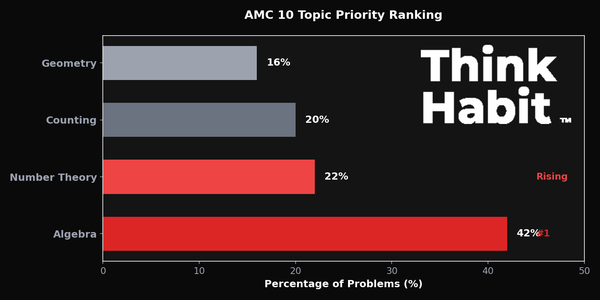
| Category | Approximate Weight |
|---|---|
| Geometry | ~30% |
| Algebra & Word Problems | ~25% |
| Number Theory | ~25% |
| Counting & Probability | ~20% |
These percentages shift slightly each year, but all four areas always appear.
1. Arithmetic & Algebra
This is the foundation. If you're shaky here, everything else becomes harder.
What you need to know:
- Operations with fractions, decimals, and percentages
- Ratios and proportions
- Rate problems (distance, time, speed)
- Basic equations and inequalities
- Linear functions and their graphs
- Word problems involving money, age, mixtures
- Sequences and patterns
- Exponents and roots
For later problems:
- Quadratic expressions (factoring, simple equations)
- Coordinate geometry basics
- Systems of equations (simple ones)
2. Geometry
Geometry shows up heavily on AMC 8. Expect it on roughly a third of the test.

What you need to know:
- Properties of triangles, quadrilaterals, and polygons
- Pythagorean Theorem (used constantly)
- Area and perimeter of basic shapes
- Circles: circumference, area, central angles
- Volume and surface area of prisms, cylinders, cones
- Angle relationships (complementary, supplementary, vertical)
- Similar and congruent figures
- Spatial visualization (unfolding boxes, counting cubes)
Key skill: Many geometry problems require combining multiple concepts. You might need the Pythagorean Theorem to find a length, then use that length to calculate an area.
3. Number Theory
This is where AMC 8 differs most from regular school math. Number theory is rarely taught well in classrooms, but it appears on every AMC 8.
What you need to know:
- Divisibility rules (2, 3, 4, 5, 6, 9, 10)
- Prime numbers and prime factorization
- GCD (Greatest Common Divisor) and LCM (Least Common Multiple)
- Remainders and modular arithmetic basics
- Perfect squares and cubes
- Digit problems (place value, sum of digits)
- Odd and even number properties
Why it matters: Number theory problems often look simple but require careful logical thinking. This is exactly what AMC 8 is designed to test.
4. Counting & Probability
Another area that school math tends to skim over, but AMC 8 takes seriously.
What you need to know:
- Basic counting principles (addition and multiplication rules)
- Permutations and combinations (at an introductory level)
- Probability of single and multiple events
- Expected value (basic understanding)
- Venn diagrams
- Logical reasoning and casework
Common trap: Students often undercount or overcount. Learning systematic counting methods is essential.
Topics That Also Appear
These don't fit neatly into one category but show up regularly:
| Topic | What to Know |
|---|---|
| Graphs & Tables | Reading data, interpreting charts, finding averages |
| Estimation | Approximating answers, order of magnitude |
| Logic Puzzles | Process of elimination, working backwards |
| Patterns | Recognizing and extending sequences |
| Everyday Applications | Real-world scenarios involving math |
What's NOT on AMC 8
Just as important—here's what you don't need to study:
- Trigonometry
- Advanced algebra (complex numbers, matrices)
- Calculus
- Formal proofs
- Statistics beyond basic mean/median/mode
School Math vs. AMC 8
Here's the key difference:
School math: Learn a concept → Practice similar problems → Apply the same method
AMC 8: See an unfamiliar problem → Figure out which concepts apply → Combine them creatively
The topics are middle school level. The thinking required is not.
A student who has memorized every formula but can't adapt to new situations will struggle. A student who deeply understands fewer concepts but thinks flexibly will do better.
How to Use This Information
Don't just read through topics and check them off. For each area:
- Make sure you understand the concepts, not just the procedures
- Practice problems that combine multiple topics
- Work on problems slightly harder than your comfort zone
- When you get something wrong, figure out why—not just what the answer was
The goal isn't to memorize AMC 8. It's to build the kind of thinking that handles whatever AMC 8 throws at you.
AMC 8 covers middle school math, but it tests so much more than that. It tests whether you can think.

I'm a math coach at Think-Habits, and this is what I care about most. Going forward, I'll be sharing how AMC can help develop the problem-solving abilities that truly matter in the age of AI. My goal is to help you build the kind of thinking that will make a real difference in the world you're about to step into.
— Madison Chung